

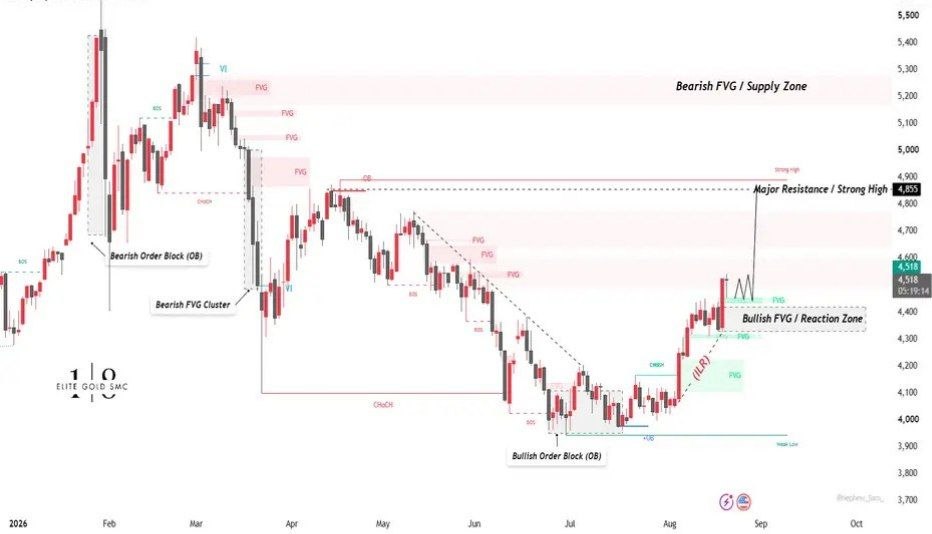
This XAU/USD 4-hour analysis focuses on market structure, liquidity, and key Fair Value Gap (FVG) reaction zones. The objective is not to predict the market direction in advance, but to monitor how price behaves around important technical areas and wait for proper confirmation before considering any trading opportunity.
Market Structure and Liquidity
The 4,100–4,300 area represents an important internal liquidity and reaction range. Price movement within this zone could provide valuable information about the next potential directional move.
Liquidity can often build above previous highs and below previous lows. Traders following a Smart Money Concepts (SMC) approach may watch for liquidity sweeps, strong displacement, and changes in market structure around these key areas.
Key Supply and Demand Zones
The marked supply and demand zones highlight potential areas where XAU/USD may react.
- Supply Zone: An area where selling pressure may potentially increase.
- Demand Zone: An area where buyers may potentially step into the market.
- FVG Zones: Areas of price imbalance that may attract a retracement or reaction.
- Liquidity Levels: Previous highs and lows where stop orders and liquidity may be concentrated.
However, reaching a supply or demand zone alone should not be considered a trading signal. Price action and market structure confirmation remain important.
SMC Trading Approach
The analysis follows a structured Smart Money Concepts (SMC) approach:
- Identify Liquidity: Monitor previous highs, lows, and areas where liquidity may be resting.
- Watch Key Zones: Observe how price reacts when entering the marked supply, demand, or FVG areas.
- Wait for a Liquidity Sweep: A sweep of previous highs or lows may provide additional market information.
- Look for Displacement: A strong impulsive move can indicate increasing buying or selling pressure.
- Confirm Market Structure: Wait for a Break of Structure (BOS) or Change of Character (CHoCH).
- Define Invalidation: Identify the price level where the trading idea is no longer valid.
Why Confirmation Is Important
The key focus is how price reacts around the marked zones rather than assuming that price will automatically reverse or continue from a particular level.
For example, a trader may wait for:
- A liquidity sweep
- Strong bullish or bearish displacement
- A BOS or CHoCH confirmation
- A retest of the structure or FVG zone
- Clear risk and reward parameters
This approach can help traders avoid entering a position solely because price has reached a specific supply, demand, or liquidity zone.
Risk Management and Invalidation
Proper risk management should remain an essential part of every trading plan. Before entering a trade, traders should clearly define:
- Entry condition: The confirmation required before execution.
- Invalidation level: The point where the market structure invalidates the original idea.
- Stop-loss placement: Based on market structure rather than arbitrary distance.
- Position size: Adjusted according to acceptable risk.
- Risk-to-reward ratio: Evaluated before entering the market.
Conclusion
The XAU/USD 4H chart highlights the importance of combining market structure, liquidity, supply and demand zones, and Fair Value Gaps when analyzing potential trading opportunities.
The 4,100–4,300 reaction range remains an important area to monitor. Rather than predicting the next move, traders can wait for price to interact with the marked zones and then look for confirmation through liquidity sweeps, displacement, BOS, or CHoCH.
Market Principle: Identify the zone, wait for the reaction, confirm the structure, define the invalidation, and manage the risk.
⚠️ Disclaimer
This analysis is provided for educational and informational purposes only. It should not be considered financial or investment advice. Trading involves significant risk, and market conditions can change rapidly. Always conduct your own analysis and apply appropriate risk management before making any trading decisions.
Comments (0)
No comments yet. Be the first to comment.