

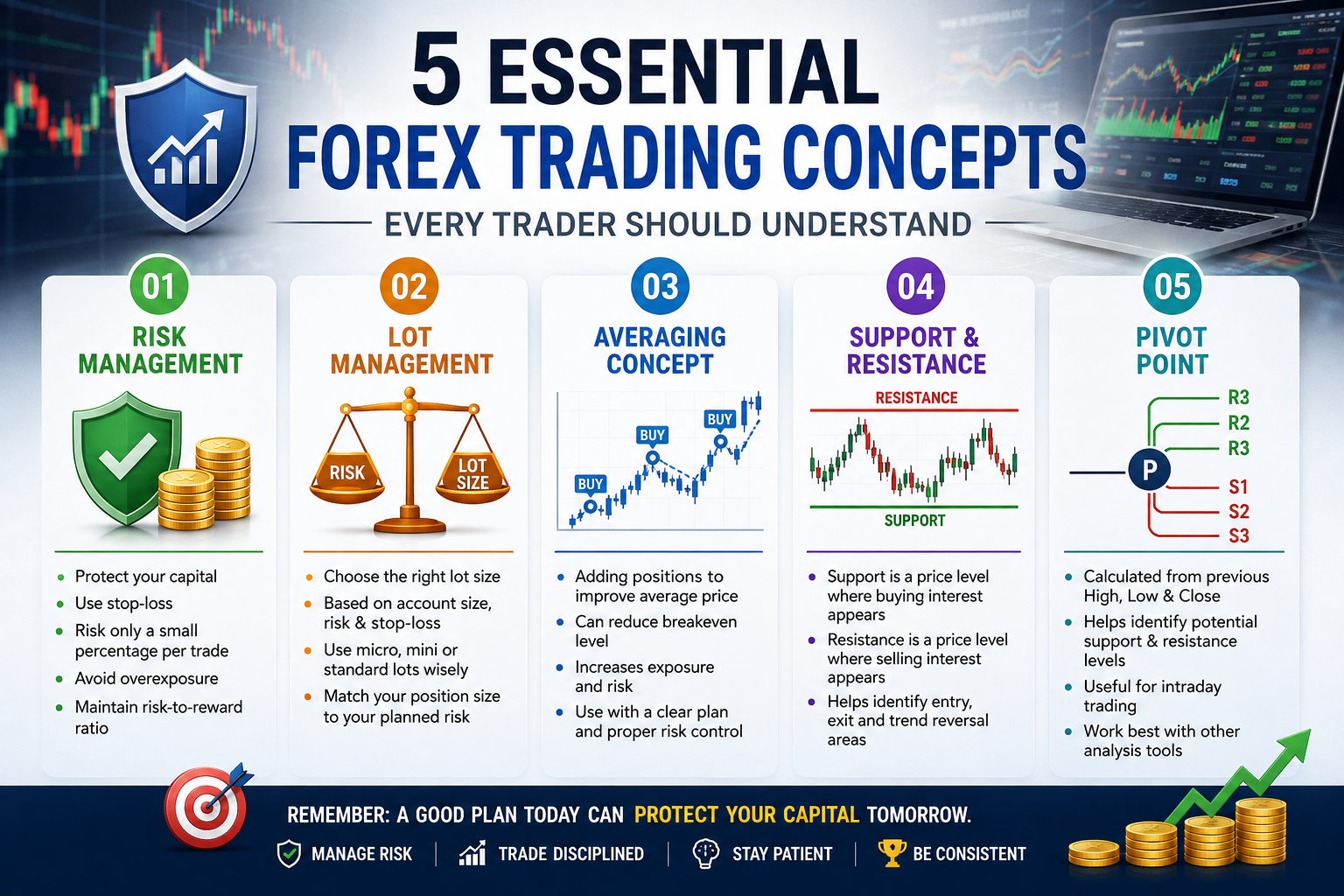
Successful Forex trading is not only about finding the right entry point. A disciplined trader should also understand risk management, lot management, averaging, support and resistance, and pivot points. These concepts can help traders make more structured decisions and manage their exposure effectively.
Important: These concepts are educational tools and do not guarantee profits. Forex trading involves significant risk, especially when leverage is used.
1. Risk Management
Risk management is the foundation of responsible Forex trading. It means controlling how much you are willing to lose on each trade and protecting your trading capital.
A trader should decide the acceptable risk before entering a position, rather than making emotional decisions after the market moves.
Key Risk Management Practices
- Set a stop-loss for trades where appropriate.
- Avoid risking too much of your account on a single position.
- Consider the potential loss before entering a trade.
- Avoid excessive leverage.
- Maintain a reasonable risk-to-reward relationship.
- Keep overall exposure under control when holding multiple positions.
Example: If a trader has a $10,000 account and chooses to risk 1% on a trade, the planned risk is $100. The position size and stop-loss should be structured so that the potential loss is consistent with that risk level.
The goal of risk management is simple: protect your capital so you can continue trading when individual trades do not go as planned.
2. Lot Management
Lot management is the process of choosing an appropriate position size for a trade. The lot size directly affects the amount gained or lost when the market moves.
Common Forex Lot Sizes
- 1.00 lot — Standard lot
- 0.10 lot — Mini lot
- 0.01 lot — Micro lot
The appropriate lot size depends on factors such as account size, risk tolerance, stop-loss distance, currency pair, and broker contract specifications.
A larger lot size can increase both potential profits and potential losses. Therefore, traders should avoid selecting a lot size simply because they want to make a larger profit.
Good lot management means matching your position size to your planned risk.
3. Understanding the Averaging Concept
Averaging means adding additional positions to an existing trade as the market moves, with the intention of changing the average entry price or managing an existing position.
For example, a trader might open a position and then add another position at a different price. The combined positions will have an overall average entry price.
However, averaging can significantly increase exposure and risk, particularly when adding to a losing position. If the market continues moving against the trader, losses can grow quickly.
Before Averaging, Consider:
- How much total exposure will the account have?
- What is the maximum acceptable loss?
- Is there a predefined exit plan?
- How much margin will the additional position require?
- What happens if the market continues moving in the same direction?
Averaging should never be treated as a guaranteed method of recovering losses. Without proper risk controls, it can turn a manageable loss into a much larger one.
4. Support & Resistance
Support and resistance are important technical-analysis concepts used to identify areas where price has previously reacted.
Support
Support is a price area where buying interest has previously helped slow or stop a decline.
Traders may watch support for:
- Potential buying opportunities
- Signs of a bounce
- Possible breaks below the level
Resistance
Resistance is a price area where selling interest has previously helped slow or stop a rise.
Traders may watch resistance for:
- Potential selling opportunities
- Signs of a rejection
- Possible breaks above the level
Support and resistance are zones rather than guaranteed exact prices. A level can also change its role: former resistance may become support after a confirmed breakout, and vice versa.
5. Pivot Points
Pivot points are technical-analysis levels calculated from previous market price data. Traders commonly use them to identify potential intraday support, resistance, and market reference levels.
A traditional pivot point is calculated using the previous period's high, low, and close:
Pivot Point (P) = (High + Low + Close) ÷ 3
Traditional pivot-point calculations can also produce levels such as R1, R2, R3 for resistance and S1, S2, S3 for support.
Traders May Use Pivot Points To:
- Identify potential support and resistance areas.
- Plan possible entry and exit zones.
- Assess intraday price movement.
- Combine pivot points with other technical indicators.
Pivot points should not be viewed as guaranteed turning points. They work best as one part of a broader trading analysis.
Bringing the Concepts Together
These five concepts can complement each other:
Risk Management → Lot Management → Entry Analysis → Trade Management → Exit Planning
For example, a trader could identify a potential setup near a support zone, use a pivot point as an additional reference, determine an appropriate stop-loss, calculate a suitable lot size based on the planned risk, and establish an exit strategy before entering.
Final Takeaway
Good Forex trading is not simply about predicting whether price will go up or down. It is about managing uncertainty.
Understanding risk management, lot management, averaging, support and resistance, and pivot points can help traders develop a more disciplined approach to the market.
Protect your capital first. Manage your exposure carefully. Trade with a plan—not with emotion.
Comments (0)
No comments yet. Be the first to comment.