

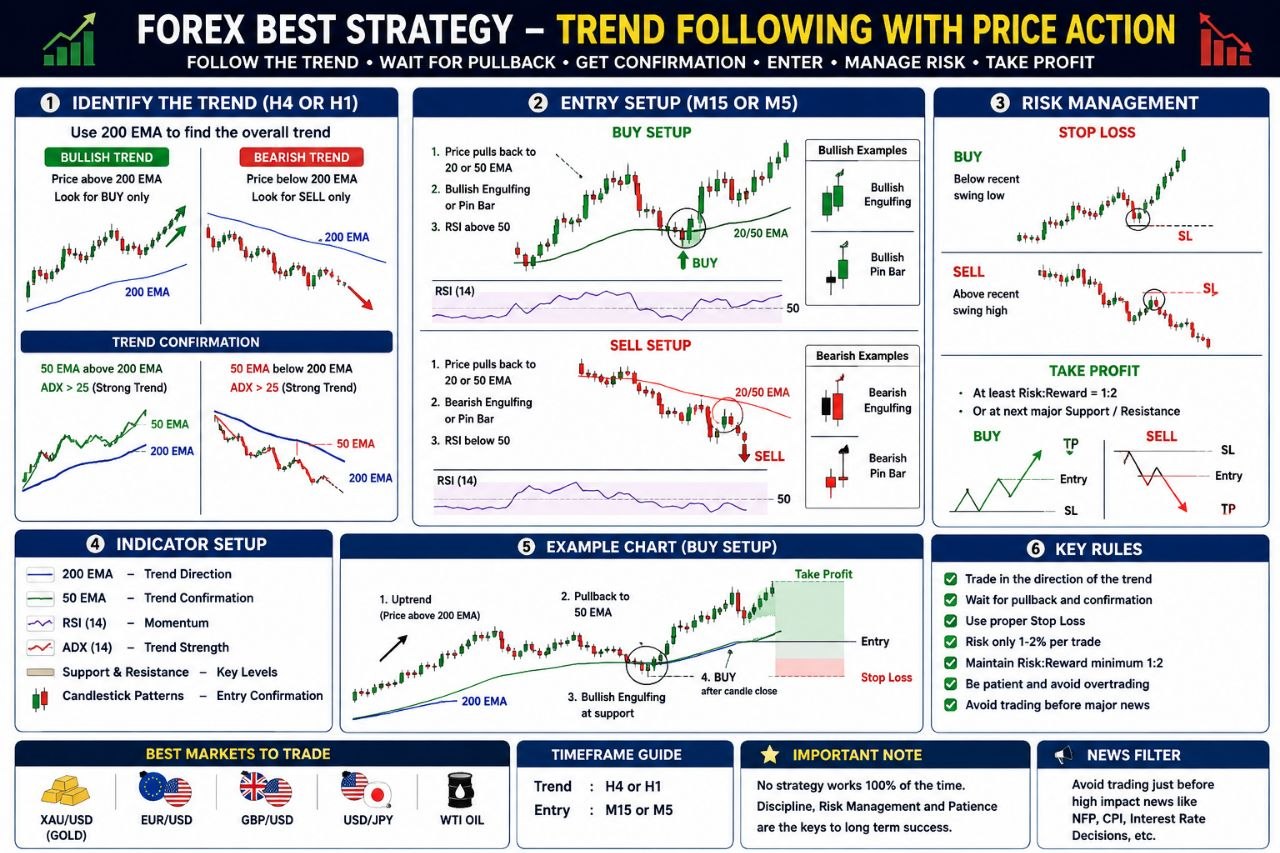
This trend-following strategy combines market structure, moving averages, price action, momentum, and risk management. The approach can be divided into six key steps, starting with identifying the overall trend and ending with disciplined trade management.
1. Identify the Trend (H4 or H1 Timeframe)
The strategy starts by using the 200 EMA on the H4 or H1 timeframe to establish the overall market direction.
🟢 Bullish Trend
When price is trading above the 200 EMA, the market is considered to be in a bullish environment. Traders can focus primarily on potential BUY setups.
🔴 Bearish Trend
When price is trading below the 200 EMA, the market is considered to be in a bearish environment. Traders can focus primarily on potential SELL setups.
Trend Confirmation
The 50 EMA and ADX can provide an additional layer of trend confirmation.
- 50 EMA above 200 EMA + ADX above 25: Strong bullish trend confirmation.
- 50 EMA below 200 EMA + ADX above 25: Strong bearish trend confirmation.
The ADX filter can help identify whether the market has sufficient trend strength. Low-ADX environments may indicate choppy or range-bound conditions where trend-following strategies can be less effective.
2. Entry Setup (M15 or M5 Timeframe)
Once the overall trend has been identified on the higher timeframe, traders can move to the M15 or M5 timeframe to look for potential entry opportunities.
📈 Buy Setup – In an Uptrend
- Wait for price to pull back toward the 20 EMA or 50 EMA.
- Look for a bullish engulfing candle or bullish pin bar.
- Confirm that RSI (14) is above 50.
- Consider entering after the confirmation candle closes.
📉 Sell Setup – In a Downtrend
- Wait for price to pull back toward the 20 EMA or 50 EMA.
- Look for a bearish engulfing candle or bearish pin bar.
- Confirm that RSI (14) is below 50.
- Consider entering after the confirmation candle closes.
This is a pullback-entry approach rather than a strategy based on chasing breakouts. The objective is to participate in an established trend after price retraces toward a potentially favorable entry area.
3. Risk Management
Risk management is one of the most important parts of any trading strategy. A technically strong setup can still result in a loss, so every trade should have a clearly defined invalidation point.
🛑 Stop Loss
- BUY trades: Place the stop loss below the recent swing low or another clearly defined invalidation level.
- SELL trades: Place the stop loss above the recent swing high or another clearly defined invalidation level.
🎯 Take Profit
- Target a minimum 1:2 risk-to-reward ratio, where appropriate.
- Alternatively, consider the next major support or resistance level as a potential target.
The exact stop-loss and take-profit placement should be based on the market structure rather than using the same fixed distance on every trade.
4. Indicator Setup Reference
The strategy uses a combination of indicators and price-action tools, with each serving a specific purpose.
| Tool | Purpose |
|---|---|
| 200 EMA | Overall trend direction |
| 50 EMA | Trend confirmation |
| RSI (14) | Momentum confirmation |
| ADX (14) | Trend strength |
| Support & Resistance | Important market levels |
| Candlestick Patterns | Entry confirmation |
5. Example Walkthrough
A typical BUY setup can follow this sequence:
- Uptrend established: Price is trading above the 200 EMA.
- Pullback: Price retraces toward the 50 EMA.
- Support reaction: Price reaches a potential support area.
- Bullish confirmation: A bullish engulfing candle forms.
- Entry: A BUY position can be considered after the confirmation candle closes.
- Stop Loss: Positioned below the relevant swing low.
- Take Profit: Positioned around the next major resistance area or according to the planned risk-to-reward ratio.
This sequence helps traders avoid entering simply because price is moving upward. Instead, the trader waits for the trend, pullback, and confirmation to align.
6. Key Rules Checklist
- ✅ Trade with the trend rather than against it.
- ✅ Wait for a pullback and confirmation before entering.
- ✅ Use a proper stop loss on every trade.
- ✅ Consider limiting risk to 1–2% of account equity per trade.
- ✅ Aim for at least a 1:2 risk-to-reward ratio when the market structure supports it.
- ✅ Be patient and avoid overtrading.
- ✅ Avoid entering trades immediately before major economic news releases.
📰 Major News Events to Watch
High-impact economic announcements can cause significant volatility and unexpected price movements. Traders should be particularly cautious around events such as:
- NFP (Non-Farm Payrolls)
- CPI (Consumer Price Index)
- Federal Reserve interest-rate decisions
- Major central-bank announcements
- Other high-impact economic data
🌍 Best Markets for This Strategy
This approach can be applied to a variety of liquid financial instruments. Markets that often display periods of directional movement may be suitable for this type of trend-following approach.
- Gold (XAU/USD)
- EUR/USD
- GBP/USD
- USD/JPY
- WTI Oil
💡 Final Thoughts
The core principle of this strategy is simple: identify the trend, wait for the pullback, look for confirmation, and manage risk carefully.
Instead of chasing price after a large move, traders can wait for price to retrace toward an important moving average or support/resistance area and then look for price-action confirmation.
However, no trading strategy works in every market condition. Trend-following strategies can perform poorly during sideways or highly choppy markets. Proper risk management, patience, and consistent execution are therefore essential.
Follow the trend. Wait for the pullback. Get confirmation. Manage your risk. Stay disciplined.
⚠️ Risk Warning
Forex and CFD trading involves significant risk and may not be suitable for all investors. No trading strategy can guarantee profits. Past performance and technical patterns do not guarantee future results. Always understand the risks involved and use appropriate risk management before trading.
Comments (0)
No comments yet. Be the first to comment.